


What is Endoscopic Spine Surgery?
Endoscopic spine surgery is a minimally invasive procedure
using an endoscope with a micro-camera
to visually examine and treat spinal disorders directly.

- Compared to traditional open surgery, this method uses smaller incisions and causes less muscle damage, resulting in less pain and a quicker recovery.
Applicable Areas
Applicable to both the neck and lower back,
a customized endoscopic surgery is applied according to the patient's symptoms and lesions.
a customized endoscopic surgery is applied according to the patient's symptoms and lesions.
-

- Cervical Spine (Neck)
-
Treatable for cervical disc herniation,
cervical spinal stenosis, etc.
-

- Lumbar Spine (Lower Back)
-
Applicable for lumbar disc herniation,
spinal stenosis, and various other disorders
When Is Surgery Absolutely Necessary?
Surgery is determined based on a precise diagnosis, considering
the patient’s age, location of the lesion, disc condition, and overall health.
the patient’s age, location of the lesion, disc condition, and overall health.
-

- Severe tingling or pain
in arms or legs due to
disc or stenosis
- Severe tingling or pain
-

- Symptoms persist despite
medication or injection therapy
- Symptoms persist despite
-

- General anesthesia is
risky due to age, diabetes,
or heart disease
- General anesthesia is

Depending on the patient’s condition and lesion location,
either unilateral or biportal endoscopy is selected for optimal results.
either unilateral or biportal endoscopy is selected for optimal results.
-
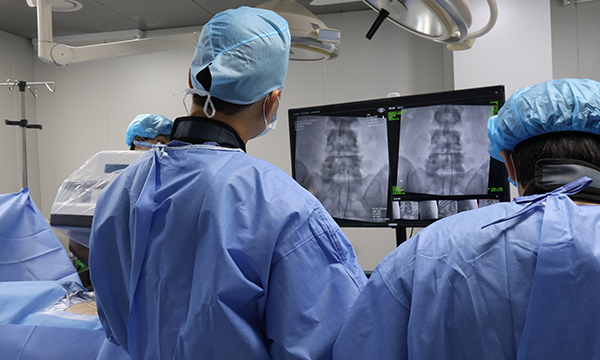
Unilateral Endoscopic Spine Surgery
-
- A single small incision (0.5–1 cm) for inserting both the endoscope and instruments
- Shorter procedure time, lower risk of bleeding or infection
- Effective for relatively simple conditions like disc removal
-
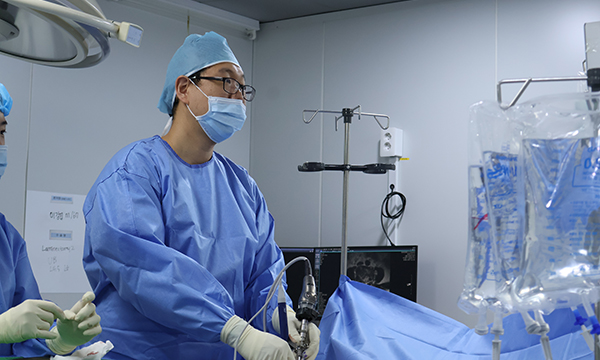
Biportal Endoscopic Spine Surgery
-
- Two micro incisions for separate insertion of endoscope and instruments
- Offers a wider surgical view and allows for more precise operation
- Suitable for complex conditions such as stenosis or severe adhesions
Procedure Steps
-

- Under local anesthesia, a 0.5–1 cm incision is made for endoscope insertion
-

- The affected area is observed on a magnified screen
-

- Disc material is removed, and stenosis sites are incised or expanded
-

- Most patients can walk after a few hours of recovery